Star Shot: Buck I St Pat
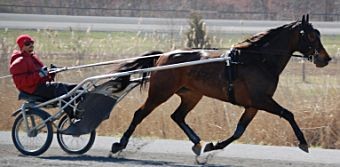
Throughout the spring, the USTA Web site will provide occasional glimpses at some of harness racing’s stars as they get ready for action on the track. This week, we take a look at 6-year-old trotting mare Buck I St Pat. USTA/Ken Weingartner photo.
Wednesday, April 01, 2009 - by Ken Weingartner, Harness Racing Communications
Freehold, NJ --- Throughout the spring, the USTA Web site will provide occasional glimpses at some of harness racing’s stars as they get ready for action on the track. This week, we take a look at 6-year-old trotting mare Buck I St Pat.
BUCK I ST PAT
Jailhouse Jesse – Name It Something – Speed In Action
Owners: Howard Taylor,
Edwin Gold, Abraham Basen, Ron Fuller
Breeder: Ron Fuller
Trainer: Ron Burke
Driver: Tim Tetrick
2008 Record: 14-10-2-1; $411,724; 1:52.2f
Career Record: 56-31-8-3; $1 million; 1:52.2f
Honors: Dan Patch and Nova awards, best older female trotter of 2008.
“That was neat,” trainer Ron Burke said. “She had enough of a season that she earned one. Even when she was younger, we thought she was capable of doing things like that, but she would make breaks or have bad luck. It was the first one for us, so it was fun.”
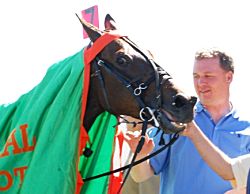 |
| Ron Burke and Buck I St Pat in the winner's circle after her world record performance in the Maxie Lee Memorial. |
Time of her life: Buck I St Pat set the world record for female trotters on a five-eighths-mile track when she won last year’s Maxie Lee Memorial in 1:52.2 on May 25 at Harrah’s Chester.
“That shows you what a special horse she is; first up against boys on windy day,” Burke said. “That’s what a world champion is supposed to be. When she’s really good, she’s just better than the horses she’s in with.”
The road back: A tendon injury forced Buck I St Pat to the sidelines following her July 12 win in the Perretti Matchmaker at the Meadowlands. She spent time in Florida, where she walked in the jog cart, before returning to normal jogging in January. She qualified on March 26 at the Meadowlands, winning in 1:55.3 with a :27.4 final quarter-mile.
“We trained her like we would normally coming back and she’s not had a bad day since she’s been back,” Burke said. “She qualified super and came out of the race fine. It’s tough to stop with one like her, but she’s such a special horse that you don’t want to take chances. Howard (Taylor) and the rest of the owners are all great. I told them I didn’t know if we can get another one like her; if we mess this one up there’s not Buck I St Pats lying around everywhere for us to buy.”
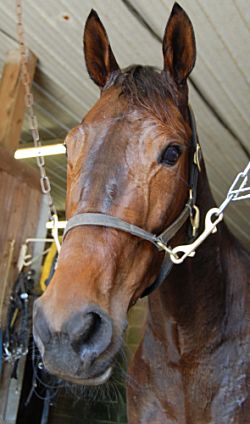 |
| Buck I St Pat broke the million dollar mark in career earnings last year. |
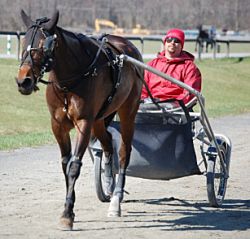
The road ahead: Buck I St Pat will make her debut in the Classic Series at Dover Downs on Monday, April 6.
“Everything seems good,” Burke said. “Basically, we’re racing her in the first leg of the series with the hope that if she’s real good she gets invited to the Elitlopp. If she does, I think we’re going to take it. She’s a 12 to 14 start per year horse now. She’ll hold up fine. She only has to race a few times every year to make a lot of money. When she’s ready, we go. When she’s not ready, we don’t go.”
Battle of the sexes: It is unlikely Buck I St Pat will face the boys too often. Last year, she defeated her male counterparts in the Maxie Lee Memorial at Harrah’s Chester and won the Mack Lobell against the boys at Pompano Park. Both Chester and Pompano are five-eighth-mile tracks.
“On the smaller tracks, she’ll take on the boys, but I’d be very hesitant to ever put her on the mile track against the boys,” Burke said. “On the smaller tracks, she doesn’t slow down too much. It plays into her hands.”
Money matters: Buck I St Pat led all trotting mares in earnings last year. Her win in the Perretti Matchmaker pushed her $1,027 above the $1 million mark in lifetime earnings.
 |
|
USTA/Ken Weingartner photos |
| Buck I St Pat will make her 2009 debut in the Classic Series on April 6. |
Positive impression: Breeder and co-owner Ron Fuller began working with Buck I St Pat almost immediately after her birth, practicing a technique known as “imprint training.” Fuller learned the method from Dr. Robert M. Miller, who advocates it to help ease handling, teach good manners, and increase responsiveness to stimuli that might later improve performance.
“When they’re a foal, their mind is like a sponge; the more you work with them, the more they remember,” said Fuller, who never tried imprint training prior to Buck I St Pat.
“We do a lot of things to make them think about things they’re going to see and do later in life. It’s a whole lot easier to work with them when they’re 150 pounds rather than 850 pounds. They remember everything. The foal is being trained for the rest of their life from the time they’re born.”